featuring world music from all points of the compass including ambient,chill,downtempo,electronic,classical,experimental,ethnic,African,European,Americas,Pacific,Asia,Indigenous,compilation albums
Wednesday, February 19, 2020
Klezmer...Yiddish Swing Music...various artists compilation
Klezmer is a musical tradition of the Ashkenazi Jews of Eastern Europe. Played by professional musicians called klezmorim in ensembles known as kapelye, the genre originally consisted largely of dance tunes and instrumental display pieces for weddings and other celebrations. In the United States the genre evolved considerably as Yiddish-speaking Jewish immigrants from Eastern Europe, who arrived between 1880 and 1924, came into contact with American jazz. During the initial years after the klezmer revival of the 1970's, the American sub-variety was what most people knew as klezmer, although in the 21st century musicians began paying more attention to the original pre-jazz traditions as revivalists including Josh Horowitz, Yale Strom and Bob Cohen have spent years doing field research in Eastern/Central Europe. Additionally, later immigrants from the Soviet Union, such as German Goldenshtayn, took their surviving repertoires to the United States and Israel in the 1980's.
Compared with most other European folk-music styles, little is known about the history of klezmer music, and much of what is said about it remains uncertain. There is, however, a heavy influence of Romani music, since many Jews and Roma lived side by side in Europe.
1 –Bagelman Sisters With Abe Ellstein Orchestra A Vaibele A Tsnien
2 –Dave Tarras, Beresh Katz, Abe Schwartz Ch'sidishe Nigunim
3 –Naftuie Brandwein Das Teureste In Bukowina
4 –Alexander Olshanetsky, Aaron Lebedeff What Can You Mach ? S'is Amarica
5 –Brandwein Der Terk In America
6 –Jacob Hohhman, Kandel's Orchestra Doina And Hora
7 –Naftule Brandwein Freilicher Yontov
8 –Naftule Brandwein Freit Sich, Yiddelach
9 –Steiner Haneros Haluli
10 –Naftule Brandwein Heiser Bulgar
11 –Seymour Rechtzeit, Abe Ellstein Orchestra Hopkele
12 –Naftule Brandwein Kleine Princessin
13 –Ziganoff Koilen
14 –Naftule Brandwein Naftule Spielt Far Dem Rebin
15 –Russkyl Orchestra Moskva Pas D'espan
16 –Abe Schwartz Orchestra Sher
17 –Abe Schwartz Orchestra Unzer Toirele
18 –Yiddish Swing Orchestra Bridegroom Special
19 –Joseph Cherniasvksy Yiddish American Jazz Band Yiddisher March
20 –Abe Ellstein Orchestra Second Avenue Square Dance
Klezmer
Labels:
compilation,
Eastern Europe,
European,
Folk,
Folk Roots,
Israel,
Jewish,
Klezmer,
Romani,
Swing,
Yiddish
Wednesday, December 11, 2019
Putumayo Summer Party Sampler....by various artists
Tracklist
1 –Culture Why Am I A Rastaman? 4:13
2 –Rita Ribeiro Cocada 3:53
3 –Hisham Abbas Intil Waheeda 4:21
4 –Los 50 De Joselito Montañerisimo 2:24
5 –Miriam Makeba Masakhane 4:45
6 –Habib Koité Batoumambe 4:16
7 –La Calaca Rogaciano 3:20
8 –Big Days Spirit Of Cropover 4:37
Labels:
African,
Arabic,
Carribean,
compilation,
Latin,
Mexico,
Putumayo,
various artists
Wednesday, October 23, 2019
Didgeralia by David Hudson....rhythms with percussion and didgeridoo
Didgeridoo - the worlds oldest musical instrument. This is a textured musical creation of percussion with the ageless sound of didgeridoo, creating rhythms and tempos that will enrich and enlighten the listener.
As any music goes it is a matter of personal taste. If you are a person who loves to listen to the oldest wind instrument of man, loves aboriginal musical sound, and enjoys the calming affects of rhythm, this is the music for you. You will also hear some of the tribal drumming along with the Didgeridoo.
David Hudson is, hands down, the master of Didgeridoo music. Great for meditation, mystical practices, or just listening. It's hard to describe the feelings that his music invokes. You have to try it for yourself. Kick your shoes off, lie back, close your eyes and enjoy.
official website: https://www.davidhudson.com.au
Sunday, September 22, 2019
Nigeria Soul Fever..Afro Funk, Disco and Boogie...West African Disco Mayhem!
Soul Jazz Records' Nigeria Soul Fever is their first release to explore the vast wealth of Nigerian music recorded in the 1970's. The album comes with introductory sleeve-notes by Bill Brewster (author of Last Night A DJ Saved My Life).
Packed full with Afro-Funk, Disco, and Boogie all from Nigeria, this set brings together a stunning collection of diverse West African sounds. Whilst a small handful of the artists featured (Joni Haastrup, Tee Mac, Christy Essien) have seen the light of day outside Africa, this is essentially a collection of killer tracks by an array of artists completely unknown outside of Nigeria. Artists include such as Don Bruce and The Angels, Akin Richards and The Executives, Angela Starr, and Jimmy Sherry and The Music Agents. It's no surprise that these records are extremely rare and expensive to buy individually so this album will save you going broke trying to find them.
These recordings were made at a time when Nigeria's trade restrictions banned imported records. Whilst new musical trends (such as American soul, funk, disco etc.) entered and influenced the country, the local music scene remained just that - local. Consequently, these recordings remain practically unknown to anyone outside of the country.
Labels:
1970's,
African,
Afro-Funk,
Boogie,
compilation,
Disco,
Nigeria,
Nigerian,
various artists,
West Africa
Monday, August 5, 2019
Madredeus...Faluas Do Tejo: Lisboa 2005...Portugese folk in purest form
In Faluas do Tejo, Madredeus presents a collection of songs about the city of Lisbon. The arrangements are mostly simple and folksy, showcasing Teresa Salguero's voice in its purest form.
"Lisboa, Rainha do Mar" opens the album with a light barcarole-sounding song that immediately conjures images of the Tagus river.
"Nevoas da Madrugada" carries a simple melody and light musical arrangement.
"O Cais Distante" is a moody, almost bluesy meditation.
"Na Estrada de Santiago" is a speak-sing number where Teresa sings a beautiful background melody that reinforces the power of her spoken parts.
"La de Fora" stands out as a happy, almost dance-able tune that has an alternating root-fifth bass line.
"O Canto do Saudade" finishes the album with a seaside, drink-in-hand feel that makes you want to start all the songs over again from the beginning. Notably, Teresa sings in a lower range for this song and you get to hear a different tone that is much more comfortable to the ear, especially if you don't like her very high parts.
Enjoy the virtual trip to Lisbon.
Labels:
Europe,
European,
Folk,
Folk Roots,
Lisbon,
Madredeus,
Portugal,
Portugese,
Teresa Salguero
Wednesday, July 17, 2019
The Rough Guide to Irish Music...various artists compilation
Tracklist:
–Dolores Keane Solid Ground
–Altan Tommy Peoples / The Windmill / Fintan McManus'
–Clannad Coinleach Ghlas An Fhómhair
–Eileen Ivers On Horseback
–Kevin Crawford Season Of Mists
–Déanta The Lakes Of Pontchartrain
–Patrick Street The White Petticoat / The Kerry Jig / Katy Is Waiting
–Sliabh Notes Terry 'Cuz' Teahans Polka / Murphy's Polka / O'Sullivan's Polka
–Dervish Molly And Johnny
–Joe Derrane With Carl Hession Humours Of Lissadell / Music In The Glen / Johnson's
–Ciaran Tourish & Dermot McLaughlin The Boys Of Malin / The Gravel Walks
–Cran Dulman / Charlie O'Neill's Highland
–Brendan Larrissey Mist On The Mountain / Three Little Drummers
–Siobhan O'Donnell, Karen Tweed, Andy Cutting Untitled / Untitled / Hand Me Down The Tackle
–Maighréad Ní Dhomhnaill Colm Cille Na Féile
–Martin Murray Sod Of Turf / Katie Goes To Granny
–Martin Hayes O'Connel's March/ Galway Bay Hornpipe / The Banshee's Wail / Over The Mangle Pit
Tuesday, May 21, 2019
Zulya Kamalova...Russian-Australian artist...first 2 albums...Journey of Voice and Aloukie
Zulya grew up in Tatarstan and began performing and writing music at age 9. She is of Volga Tatar background. In 1991, she moved to Australia, settling in Hobart, Tasmania. After extensive performing solo and with accompanists and releasing several limited-run cassettes and a full-length album Journey of Voice, she moved to Melbourne. She later formed the band Children of the Underground and signed to Melbourne-based independent record label Unstable Ape Records in 2004.
Zulya is known for her interpretations Tatar and Russian music, often playing with a backing band Children of the Underground. Instrumentation typically includes accordion, double bass, percussion, guitar, brass and string arrangements and occasionally jaw harp.
official website: https://zulya.com
Lullaby (Tatarstan / Russia)
Tuesday, April 30, 2019
Songs for Desert Refugees...a compilation in aid of the refugees from Northern Mali
Songs for Desert Refugees features a superb mix of desert music, including rare or unreleased tracks by some of the world's best-known Touareg groups, from Mali (Tinariwen, Tamikrest, Terakaft, Tartit), Niger (Bombino, Toumast, Etran Finatawa) and Algeria (Nabil Baly Othmani, Faris). The music on this compilation is the sound of what the Malian deserts can be; intense, joyful, beautiful, proud, poetic and peaceful. It is dedicated to all those who are working to make it so again. All involved in producing the album gave their services for free. Other artists include: Ibrahim Djo Experience, Amanar and Tadalat.
As with 2005's Rough Guide to the Sahara, the 12 tracks, most previously unreleased and all postdating that prophetic piece of genre-making, progress like a single expression toward the showy new jack guitars of Tadalat and Bombino and the overdue female voices of Toumast and Tamikrest. --MSNBC Expert Witness
...the album as it stands is masterful, and certainly one of the strongest world music albums of the year. It serves equally well as an introduction to this exciting strain of guitar-based African music and as a new set of tunes for listeners already familiar with the genre. --Popmatters
1. Amous Idraout Assouf d'Alwa (Tinariwen)
2. Warktifed (Tamikrest)
3. Blues du Désert Part 1 (Ibrahim Djo Experience)
4. Derhan Alkher (Faris & Terakaft)
5. Teswa Ténéré Desert Version (Nabil Baly Othmani)
6. Ténéré (Amanar)
7. Taghdart (Tadalat)
8. Gourma (Etran Finatawa)
9. Nak Essanagh (Terakaft)
10. Aïtma (Toumast)
11. Tigrawahi Tikma Live Version (Bombino)
12. Tihou Beyatene (Tartit)
Labels:
Africa,
African,
African Blues,
Algeria,
compilation,
Mali,
Niger,
Tinariwen,
various artists
Sunday, March 3, 2019
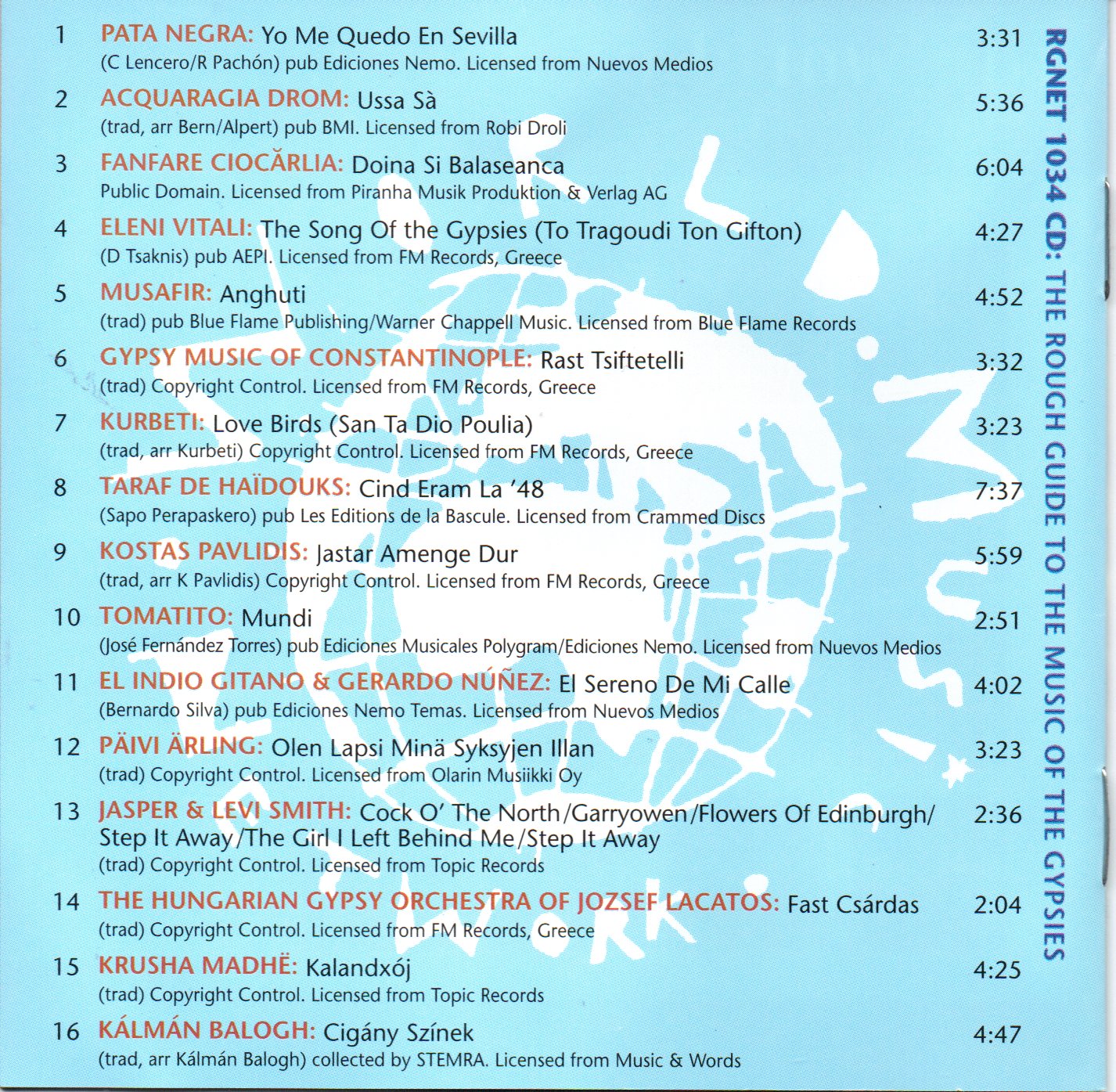
The Rough Guide to the Music of the Gypsies....various artists
The great thing about the compilers of the Rough Guide albums has always been the enormous breadth of styles that they attempt to incorporate into whatever compilation they're making. The music on this album ranges quite literally from India to Finland to England and all points in between.
The album starts out with an example of modern flamenco from Pata Negra, then moves into Italian gypsy music and an ultra-high-speed number from the Romanian Fanfare Ciocarlia. It then moves immediately into a slow lament from Greek singer Eleni Vitali. From this odd juxtaposition, it progresses into Rajasthani music, and then back to Asia Minor with a group from Istanbul. A selection from Albania follows, followed itself by the new ambassadors of gypsy music, Taraf de Haidouks. Another Greek musician makes an appearance, followed by a pair of flamenco works, one from the guitar master Tomatito and one from El Indio Gitano and Gerardo Núñez. The album then makes another heavy-duty stylistic change as it jumps to Finnish gypsy love songs and English harmonica-based folk songs.
The album then returns to the more prototypical gypsy sound, with a Hungarian group reminiscent of early klezmer in many respects. A strained shawm-based dance from Kosovo follows, providing a look into the practice of instrument adoption into a culture. The album finishes off with cimbalom master Kálman Bálogh and his arrangement of a traditional number based on styles from Spain, Hungary, and Romania (the Spanish influence is particularly noticeable).
Tracklist:
1 –Pata Negra Yo Me Quedo En Sevilla
2 –Acquaragia Drom Ussa Sà
3 –Fanfare Ciocărlia Doina si Balaseanca
4 –Ελένη Βιτάλη The Song Of the Gypsies (To Tragoudi Ton Gifton)
5 –Musafir Anghuti
6 –Gypsy Music Of Constantinople Rast Tsiftetelli
7 –Kurbeti Love Birds (San Ta Dio Poulia)
8 –Taraf de Haïdouks Cind Eram La’ 48
9 –Kostas Pavlidis* Jastar Amenge Dur
10 –Tomatito Mundi
11 –El Indio Gitano & Gerardo Nuñez El Sereno De Mi Calle
12 –Päivi Ärling Olen Lapsi Minä Syksyjen Illan
13 –Jasper Smith, Levi Smith Cock O’ The North / Garryowen / Flowers Of Edinburgh / Step It Away / The Girl I Left Behind Me / Step It Away
14 –Jozsef Lacatos Fast Csárdas
15 –Krusha Madhë Kalandxój
16 –Kálmán Balogh Cigány Színek
Thursday, January 24, 2019
Various Artists : Routes: Africa, Europe, Asia and the World
Folk Roots Magazine celebrated its 20th Anniversary back in 1999 as the Bible, barometer and catalyst in Folk, Roots and World Music, Covering everything from American legends to English traditional heroes, from Pan-African greats to wonderful discoveries from all over the planet. This double CD set, 'Routes', was specially compiled and sequenced by Folk Roots editor and radio presenter Ian Anderson and features some of the most exciting and inspiring music from Africa, Europe, Asia and the World.
Disc 1
1 Ndar (Senegal) - Youssou NDour
2 Amarrao Con P (Cuba) - Cuarteto Patria
3 Retany (Madagascar) - Tarika
4 La Citta Del Sole (Italy) - Re Niliu
5 Kufilaw/Take Care (Somalia) - Maryam Mursal
6 Teremtes (Hungary) - Marta Sebestyen & Muzsikas
7 Shima Jima Kaisha (Okinawa) - Nenes
8 Heygana (Mali) - Ali Farka Toure
9 Zolloko San Martinak (Basque Country) - Kepa, Zabaleta & Motriku
10 Ya Izzana (Sudan) - Abdel Aziz El Mubarak
11 Honsafotter/Gulerotter (Sweden) - Filarfolket
12 Amadou Faal (Gambia/Senegal) - Dembo Konte/Kausu Kuyateh
13 Guru Bandana (India) - Ali Akbar Khan/Asha Bhosle
14 I, Voyager (UK) - Trans-Global Underground
15 Lilizela Mlilizeli (South Africa) - Mahlathini & The Mahotella Queens
============================================================
Disc 2
1 Orgullecida (Cuba) - Buena Vista Social Club
2 Maacina Tooro (Senegal) - Baaba Maal/Mansour Seck
3 Stis Akres Apta Matia Soy (Greece) - Eleftheria Arvanitaki/Stavros Logarides
4 Gamen (Sweden) - Garmarna
5 Lela-Lela (Congo) - Kanda Bongo Man
6 Ka Lei E (Hawaii/US) - Bob Brozman/Ledward Kaapana
7 Haidara (Guinee) - Jali Musa Jawara
8 Nikala (UK) - Najma
9 Speed The Traktor (Szegerely) - 3 Mustaphas 3
10 Oro Negro (Equatorial Guinea) - Hijas Del Sol
11 Sorban Palid (Indonesia) - Euis Komariah/Yus Wiradiredja
12 Urombo (Zimbabwe) - Thomas Mapfumo
13 El Gustito (Mexico) - Los Camperos De Valles
14 Zobi La Mouche (France) - Les Negresses Vertes
15 Malako (Kenya) - Samba Mapangala/Orchestre Virunga
Thursday, December 13, 2018
Kadonnut Manner - The First Train to Kajanaland (Finnish Primitive Guitar / solo instrumental fingerpicking)
Guitarist Lauri Manner, aka Kadonnut Manner, has recently released his album "The First Train to Kajanaland - Finnish Primitive Guitar vol. 2". Kajanaland (or nowadays more usually Kainuu) is the region in Northern Finland where he is from, and on the cover is a photo of the first train arriving there in 1905.
Kadonnut Manner means "The Lost Continent", a kind of a pun on his last name that also sounds appropriate for making music while living on the European continent at times like these.
"Finnish Primitive Guitar" means it's guitar music very much influenced by John Fahey and other American Primitive Guitar players, and it's composed and played by a Finn. It's rhythmic and hypnotic music, scary and dissonant at some times, silly and playful at other and not overtly repetitive or pretentious at any point. The most usual feedback he gets from my live shows and music overall is that the listeners start floating off to elsewhere, conversations end in mid-sentence people and start recalling memories they didn't remember having.
He was born in 1983 in Suomussalmi, took trumpet lessons and played in a brass band when he was 10, took up bass guitar when he was 15, dropped out of all formal music studies, formed a punk band and never looked back. Besides playing both kinds of music (punk and hardcore) he was always into "classic" rock, blues and the roots of the whole thing, so starting from some CCR tapes his uncle gave him when he was 10 years old, he got into Allman Brothers, country blues of Mississippi John Hurt, Skip James, Blind Blake and all those early acoustic blues players.
Finally discovering John Fahey, Robbie Basho and Jack Rose playing this really unique music that has the drive and rhythm of the blues but with musical ideas that are all over the place was the thing that forced him to start learning fingerpicking guitar in 2015.
stream the album at the service of your choice:
Bandcamp: https://kadonnutmanner.bandcamp.com/album/the-first-train-to-kajanaland
Spotify: https://open.spotify.com/album/6IrDIIu1SefefbN5MBG801?si=o_eDTHiMSAu8FpZda2F2uQ
Deezer: https://www.deezer.com/us/album/68095612
iTunes: https://itunes.apple.com/us/album/first-train-to-kajanaland-finnish-primitive-guitar/1410391074
Sunday, October 28, 2018
Ali Farka Touré...Niafunké...West African blues..a traditional album concerning Mali
Ali Ibrahim "Ali Farka" Touré (31 October 1939 – 6 March 2006) was a Malian singer and multi-instrumentalist, and one of the African continent's most internationally renowned musicians. His music is widely regarded as representing a point of intersection of traditional Malian music and its North American cousin, the blues. The belief that the latter is historically derived from the former is reflected in Martin Scorsese's often quoted characterization of Touré's tradition as constituting "the DNA of the blues". Touré was ranked number 76 on Rolling Stone's list of "The 100 Greatest Guitarists of All Time" and number 37 on Spin magazine's "100 Greatest Guitarists of All Time".
As the first African blues man to achieve widespread popularity on his home continent, Touré was often known as "the African John Lee Hooker". Musically, the many superpositions of guitars and rhythms in his music were similar to John Lee Hooker's hypnotic blues style. He usually sang in one of several African languages, mostly Songhay, Fulfulde, Tamasheq or Bambara as on his breakthrough album, Ali Farka Touré, which established his reputation in the world music community.
Niafunké was released in 1999. The title reflects the name of the village in Mali where it was recorded. It is largely a traditional album concerning Mali.
Within the album liner notes Touré discusses his motivation for creating the album and how the music might relate to its audience. "This record is more real, more authentic. It was recorded in the place where the music belongs - deep Mali. We were in the middle of the landscape which inspired the music and that in turn inspired myself and the musicians. My music is about where I come from and our way of life and it is full of important messages for Africans. In the West perhaps this music is just entertainment and I don't expect people to understand. But I hope some might take the time to listen and learn." — Ali Farka Touré,
Niafunké marked the first of a series of albums he recorded towards the end of his career in his home town. The album was released around the same time he retired to his farm in a remote region of Mali.
find out more: https://en.wikipedia.org/wiki/Ali_Farka_Touré
official website: http://www.worldcircuit.co.uk/#Ali_Farka_Toure
Subscribe to:
Posts (Atom)